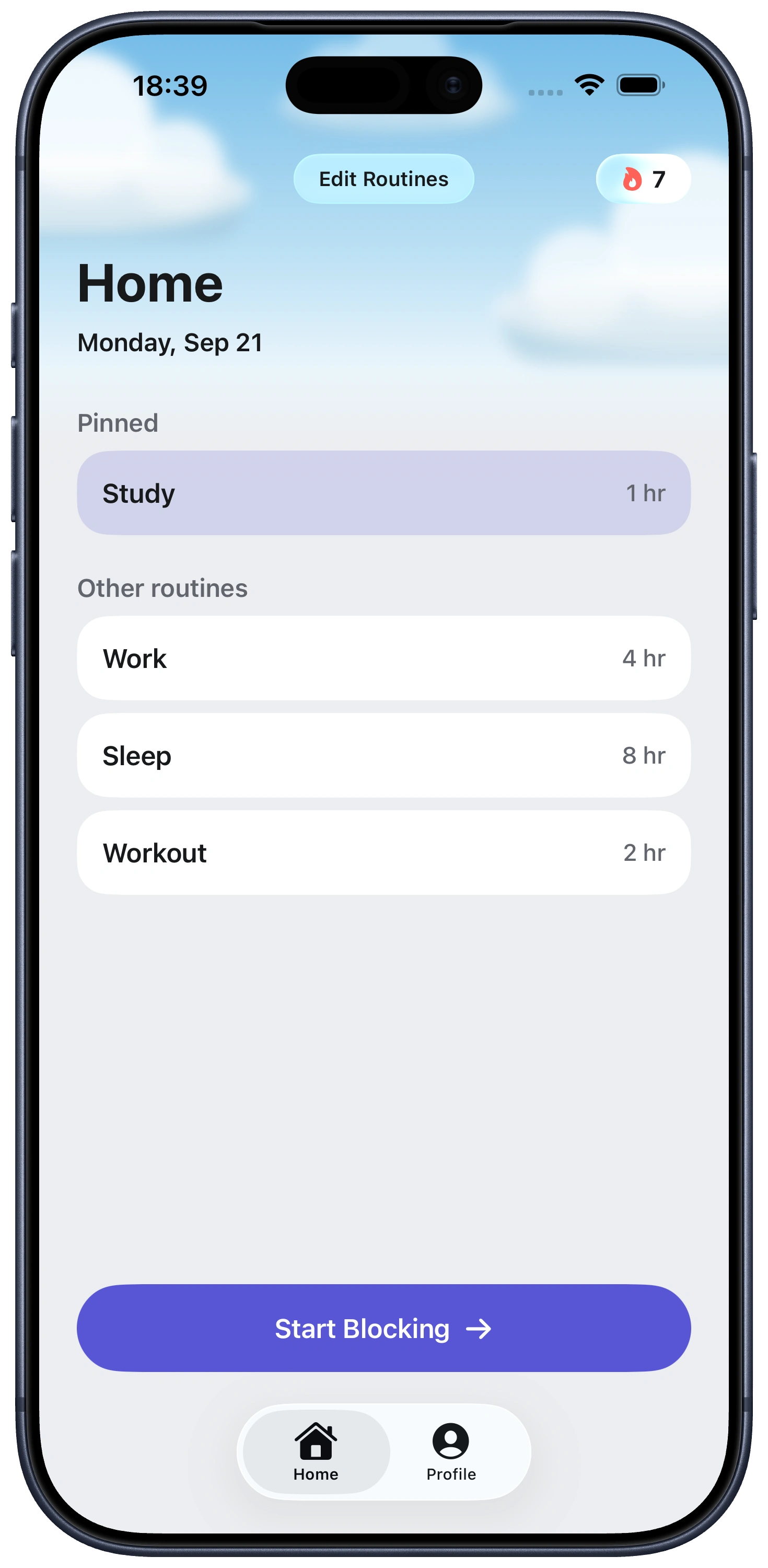
Fella vs Jomo
Jomo lets you earn your way back in.
Fella doesn't sell tickets.
Jomo unlocks apps in exchange for steps, chores, meditation, or a verified photo. Fella has one unlock a day, and there's nothing you can do to earn a second one.
Jomo is named after its own philosophy: the Joy of Missing Out. Where FOMO treats missing something as a loss, JOMO treats it as relief, and Jomo's whole design leans into making that relief feel earned and rewarding rather than just enforced. That shows up directly in how you get access back: instead of a flat no, Jomo offers a trade.
Fella doesn't offer a trade. There's no action that buys you extra time, no chore that unlocks a blocked app, no step count to hit. Selected apps stay blocked, and the only way in is the same 5-minute emergency unlock every day, regardless of what you did or didn't do that day.
Pricing mirrors that same difference in structure. Jomo's free plan covers 1 session, 1 action, and 1 screen-time budget, with an annual plan around $29.99 unlocking up to 10 sessions, Strict Mode, and Apple Health syncing, or a $99.99 lifetime purchase for everything plus family sharing. Fella is one plan, $9.99 a month or $34.99 a year with a 3-day free trial, and the daily unlock is identical no matter which you choose. Both run on Apple's Screen Time framework. What differs is whether getting back into a blocked app is something you do, or something you earn.
The unlock is a transaction, not a wait
Jomo's unlock methods are genuinely inventive. Move unlocks an app after you hit a step count or another movement goal, like a walk, a run, or a set number of calories burned. Self-Care unlocks after meditating, hydrating, going outside, or logging your mood. Scan requires physically scanning an object. To-Do asks you to finish an offline task first.
Complete Habits turns unlocking into a direct exchange. Doing the dishes can unlock 15 minutes of YouTube. Hitting 5,000 steps can fully unlock Netflix. An optional AI photo-verification step can confirm the dishes actually got done, the meal actually got finished, or the room actually got tidied, rather than trusting an honor system.
That's a real behavior-change mechanic, and it can work well. Tying a chore to a reward is a well-worn habit-stacking technique, and turning screen time into something you earn rather than something you're simply denied can make the block feel less like punishment.
But a trade is still a door, and doors get walked through on bad days. A determined person can do a quick fake-out lap around the block to hit a step count, or knock out a token chore in thirty seconds specifically to buy back Instagram. The exchange is real, but so is the ability to game it when the goal is just getting back in, not actually doing the habit. Fella has no exchange rate to game, because there's nothing being sold.
Strict Mode: powerful, but it's a setting you configure
Jomo's Strict Mode is one of the more granular lockout tools in this category. You choose when it's active, only while a block is running, at specific times, until a set date, or always on, and you choose from four separate protections that disable pausing, editing, or deleting your own rules while it's engaged. Reviewers specifically note that once it's on, it holds, and people report not bothering to try to get around it.
That's a real strength, and it comes with a real precondition. Strict Mode only protects you if you've already configured it correctly before the moment you need it, chosen the right duration, the right protections, and actually switched it on. It's a premium feature gated behind the $29.99 annual plan or the $99.99 lifetime purchase, not something free users have access to at all.
Fella doesn't have a strict setting to remember to arm. There's no configuration screen with four protection toggles and four duration options to get right in advance. The block is the only mode the app has, on every plan, from the first day of the free trial onward.
Squads add social accountability, and social pressure
Squads let you share screen time with family, friends, coworkers, or a community for mutual support. It's a free feature, and for people motivated by not wanting to look bad in front of others, that visibility can genuinely help.
It also means your blocking is no longer just between you and your phone. A squad works because someone else can see your numbers, which is a form of leverage that has to be actively maintained, kept honest, and re-engaged with, rather than something that just runs quietly in the background.
Fella has no social layer at all. The daily unlock isn't shared, reported, or visible to anyone else by design. It's a private rule, which is either a limitation or the whole appeal, depending on whether you want an audience for your screen time or specifically don't.
What you get free, and what you have to pay to unlock
Jomo's free plan is a genuinely limited trial of the product. 1 session, 1 action or limit, and 1 screen-time budget total. Strict Mode, Apple Health syncing, multiple concurrent budgets, and up to 10 sessions all sit behind the $5.99 monthly, roughly $2.49-a-month annual ($29.99/year), or $99.99 lifetime plans. A separate $14.99 annual student plan includes the same Plus features at a lower price.
Fella doesn't segment its core behavior by tier. $9.99 a month or $34.99 a year, both with a 3-day free trial, and both get the exact same single blocked state and the exact same one 5-minute daily unlock. There's no cheaper version that blocks less strictly, and no more expensive version that blocks more strictly. One plan, one rule.
What actually shows up in reviews
Jomo holds a strong 4.7 average App Store rating, and specifically on Strict Mode, users report it's effective enough that they don't bother trying to get around it, which is a meaningful signal for its toughest setting.
Outside Strict Mode, reliability reports are more mixed. Users have described syncing problems where blocking doesn't lift when a break is supposed to start, inconsistent enforcement after app updates, and screen time getting miscalculated at times. One long-term reviewer noted the app worked well initially but accumulated glitches and UI clunkiness over time, though the developers have since shipped updates specifically improving time-limit reliability and reporting accuracy.
Fella's surface area for that kind of drift is smaller by design. There's one blocked state to keep synced, not sessions, actions, budgets, habit completions, and Strict Mode durations all needing to agree with each other at once.
| At a glance | Fella | Jomo |
|---|---|---|
| How you get back in | Daily unlock, no conditions | Earned via steps, chores, self-care, or to-dos |
| Strict enforcement | Default behavior | Opt-in Strict Mode, paid tiers only |
| Social accountability | None | Squads, shared with others |
| Free plan scope | Full product, one plan | 1 session, 1 action, 1 budget |
| Sessions/rules to manage | None | Up to 10 on paid tiers |
| Daily choices | None | Ongoing |
Why people switch to Fella
Nothing to earn back means nothing to game. Jomo's habit-based unlocks are easy to satisfy with a token effort aimed only at getting back in. Fella's unlock isn't for sale at any price, so there's no shortcut version of it to find.
Strict enforcement isn't a setting you have to remember to buy and arm. Jomo's toughest mode is opt-in and gated behind a paid plan. Fella's block is the only mode there is, free trial included.
No audience required. Squads help people who want social pressure to stay honest. Fella's unlock stays private, which works for people who'd rather the rule not depend on who's watching.
Who each one actually fits
Jomo fits people who respond to earning things. If turning screen time into a reward for movement, self-care, or a finished chore actually changes your behavior, and you like the idea of a squad keeping you honest, its gamified structure is built specifically for that.
Fella fits people who don't want an exchange rate at all. If you know you'd find the fastest possible way to satisfy a habit requirement just to get back into an app, or you don't want your screen time visible to anyone else, a flat daily unlock with nothing to trade for it removes that whole layer of negotiation.
The difference is whether access should ever be earnable. Jomo says yes, with the right conditions. Fella says no, on purpose.
Fella vs Jomo FAQ
Jomo lets you unlock blocked apps by earning access through actions, like walking a step count, doing the dishes, meditating, or completing an offline to-do, verified in some cases by AI photo analysis. Fella has no action to complete. The only access is one 5-minute unlock a day, and nothing you do earns you more.
JOMO stands for the Joy of Missing Out, positioned as the opposite of FOMO. Jomo's philosophy is that blocking apps should feel rewarding rather than purely restrictive, which is why it builds unlock methods around movement, self-care, and completed tasks instead of a flat denial.
Yes. Jomo's Complete Habits feature lets you earn time on blocked apps by finishing real-world actions, for example doing the dishes unlocking 15 minutes of YouTube, or hitting a step count fully unlocking Netflix. An AI photo-verification option can confirm the action was actually done.
Jomo's Strict Mode is configurable: it can run only while blocking is active, at specific times, until a set date, or always on, and it has four separate protection toggles that disable pausing, editing, and deleting rules. Fella doesn't have a separate strict setting to configure. Every plan behaves the same way by default, with no mode to turn on first.
Squads are Jomo's free social accountability feature, letting you share screen time with family, friends, coworkers, or a community group for mutual support. Fella has no social or sharing layer. The daily unlock is a private rule between you and your phone.
Jomo's free plan is limited to 1 session, 1 action or limit, and 1 screen-time budget. The annual plan, around $29.99 a year with a 3-day trial, raises that to 10 sessions and adds Strict Mode and Apple Health integration. A $99.99 lifetime purchase unlocks everything plus sharing with 5 family members. Fella is one plan, $9.99 a month or $34.99 a year with a 3-day free trial, and the single daily unlock doesn't change or expand at any tier.
Jomo holds a 4.7 average App Store rating, and users report Strict Mode specifically is hard to talk your way around. At the same time, reviewers have reported syncing issues where blocking doesn't lift on schedule, inconsistent enforcement after updates, and occasional screen time miscalculation. Fella's single blocked-by-default state has fewer settings and rule types that can drift out of sync.
People who respond well to earning access through movement, self-care, or completed tasks, and who want social accountability through Squads or detailed session and budget controls, are likely to get more out of Jomo's gamified structure than Fella's single fixed daily unlock.
See how Fella compares to Opal, ClearSpace, AppBlock, unhookd, One Sec, Freedom, or Apple Screen Time.