Fella vs ClearSpace
A breathing exercise still lets you in.
Fella doesn't.
ClearSpace slows you down with a pause, a pushup, or a breathing exercise before an app opens. Fella skips the negotiation: blocked, with one 5-minute unlock a day.
ClearSpace is built on friction, not refusal. Try to open a distracting app and it asks for a deep breath, a short visualization, or a physical move like pushups, squats, or jump rope before letting you through. Clear the exercise and the app opens anyway, just with a self-chosen timer running in the background.
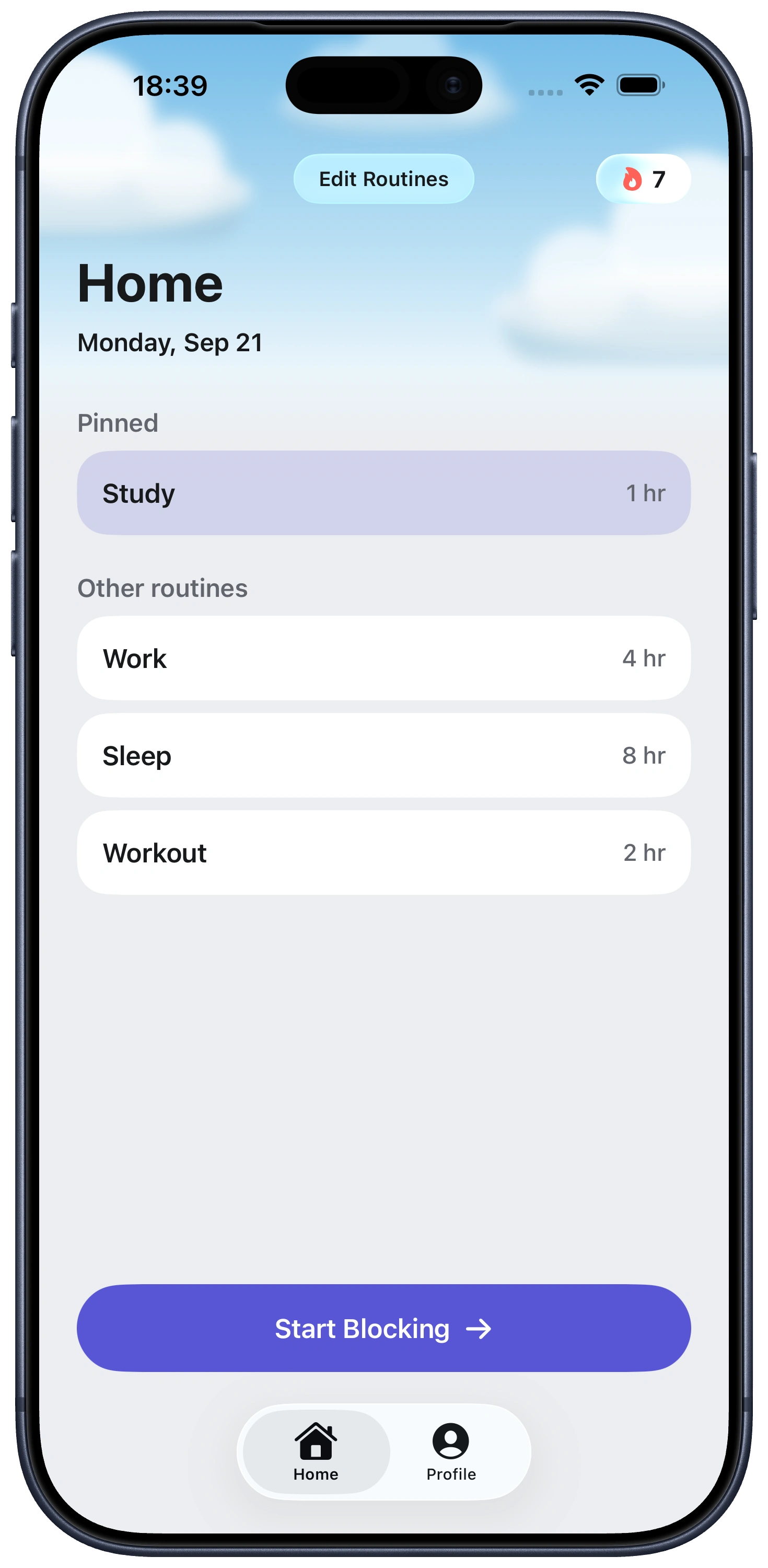
Fella doesn't ask you to earn access. There's no exercise to clear and no timer to set for yourself. Selected apps stay blocked, and the only way in is the same 5-minute emergency unlock every day, gone the moment it runs out.
Setup follows the same split. ClearSpace lets you restrict one app for free, then charges $6.99 a month for more, plus optional accountability partners and challenges to compete in. Fella asks you to pick your apps once, for $9.99 a month or $34.99 a year with a 3-day free trial, and that's the entire setup. Both run on Apple's Screen Time framework. What differs is whether a determined ten seconds of breathing gets you back into the app.
Why friction alone doesn't hold on a bad day
Friction is designed to be cleared, not to stop you. One Sec, which uses a similar pause-and-dismiss model, describes its own approach directly: friction is never meant to block a behavior entirely, it's meant to add just enough resistance that you reconsider, while keeping your ability to choose intact. That's the same philosophy ClearSpace runs on.
And it does measurably work, some of the time. A six-week field study on that same friction model found a 57% drop in actual app openings, largely driven by a moment where people were offered a chance to back out mid-open and took it. That's real behavior change, built entirely around a single moment of persuasion succeeding.
The catch is what happens when persuasion doesn't land. A breathing exercise, a pushup, or a squat takes ten to twenty seconds and asks nothing of your intent, only your effort. On the nights motivation is already gone, that effort is easy to spend and the app opens exactly as if the pause was never there. Fella doesn't route around a bad moment. It removes the door.
What ClearSpace actually asks you to do
The exercise changes, the outcome doesn't. Depending on setup, opening a restricted app might prompt a breathing exercise, a short mindfulness check-in, or a physical rep like pushups, squats, or jump rope. Complete it, and the app opens.
You still set your own limit. Once in, ClearSpace asks you to choose a timer between one and ten minutes for that session. When it runs out, it reminds you that you picked that number, but the reminder is the entire enforcement.
Strict Mode is the exception, and it's opt-in. ClearSpace's Strict Mode locks a chosen app for a set period with an irreversible warning before you turn it on, which is the closest it gets to a real hard block. It has to be manually switched on each time you want it, rather than being the app's default behavior. Fella's block is never something you have to remember to arm.
Accountability partners and challenges add motivation, not enforcement. ClearSpace lets you share progress with a partner or compete in challenges like step-to-scroll competitions. Useful for staying motivated, but neither one stops the app from opening if you decide to open it.

What actually shows up in reviews
The feedback is genuinely split. Several users say the light-touch nudges worked quickly and didn't feel harsh, which lines up with how ClearSpace is designed to feel. Others describe a slow, laggy interface with multi-second delays after each tap, confusing onboarding, and unclear limits on the free tier.
The browser extension has a documented gap. Reviews describe the Chrome extension specifically as bypassable, since navigating to a page other than the blocked homepage can route around the restriction entirely. It's also billed as a separate subscription from the app.
Fella has fewer places for something to go wrong. One blocked state, one daily unlock, no separate extension subscription, no per-session timer to configure. The simplicity is partly a design choice and partly a side effect of having far less surface area to break.
| At a glance | Fella | ClearSpace |
|---|---|---|
| Ways past the block | 1 | Breathing, pushups, squats, jump rope, or skip |
| Timer after entry | None | Self-chosen, 1-10 minutes |
| Strict enforcement | Default behavior | Opt-in Strict Mode, armed manually |
| Daily choices | None | Ongoing |
| Extra subscriptions | None | Separate charge for browser extension |
Why people switch to Fella
No exercise doubles as a loophole. A pushup or a deep breath is easy to clear on purpose, and once it's cleared, the app opens anyway. Fella has no exercise to pass, because passing one was never the point.
No timer to set for yourself. ClearSpace asks you to pick how long you'll allow, every time, which means the decision you were trying to avoid comes right back. Fella's one 5-minute unlock a day is already decided, and it isn't yours to extend.
Nothing to configure wrong. Challenges, accountability partners, and Strict Mode windows are all extra settings to manage. Fella keeps that list short on purpose, so there's no feature to lean on instead of just staying blocked.
Who each one actually fits
ClearSpace fits people who mostly need a reminder. If a short pause is usually enough to make you close the app yourself, and you want accountability partners or challenges for extra motivation, its lighter-touch model is built for exactly that.
Fella fits people whose willpower already lost the negotiation. If you know a breathing exercise wouldn't stop you, or if you've caught yourself clearing a pause on purpose just to get back in, a fixed daily unlock removes the moment where that negotiation happens at all.
Some people need both at different times. ClearSpace's friction can be the right amount of resistance on an easy day. Fella is built for the days friction alone won't hold.
Fella vs ClearSpace FAQ
ClearSpace adds friction before an app opens, like a breathing exercise, a pushup, or a short visualization, then lets you in with a self-chosen timer. Fella has no exercise to clear. Selected apps stay blocked, and the only access is one 5-minute emergency unlock per day.
Yes. ClearSpace's own design lets you choose to proceed after the pause, and app store reviews describe the Chrome extension specifically as bypassable by navigating away from the blocked homepage. The friction is meant to slow a decision, not remove the option.
A field study on One Sec, a similar friction-based app, found a 57% drop in app openings over six weeks, largely because a dismiss option let people back out mid-open. That's real, measured impact, but it's built around a moment of persuasion, not a rule that holds when persuasion fails.
ClearSpace lets you restrict one app for free and charges $6.99 a month for more apps, accountability partners, and challenges. Fella is $9.99 a month or $34.99 a year with a 3-day free trial, and every plan includes the same one blocked-by-default setup.
Strict Mode is an optional setting that locks a chosen app for a set period with an irreversible warning before you turn it on. It's the closest ClearSpace gets to Fella's default behavior, but it has to be manually switched on each time, rather than being how the app always works.
Reviews describe mixed reliability: several users report meaningful reduced screen time from the light-touch nudges, while others cite a slow, laggy interface, confusing onboarding, and unclear free-tier limits. Fella's single blocked state has fewer moving parts to go wrong.
People who mostly need a reminder to pause, respond well to a brief physical or mindful interruption, and want accountability partners or challenges to stay motivated may prefer ClearSpace's lighter-touch approach over Fella's stricter default block.