Pomodoro Focus
A timer protects
the session. Not the break.
Most Pomodoro apps just count down 25 minutes; nothing stops you switching apps mid-session or during the break after it. Fella blocks distracting apps all day, covering the gap a timer alone leaves open.

Knowledge workers already switch between tools roughly 47 times a day, with interruptions arriving every 3 to 4 minutes and a single one costing over 23 minutes to fully recover from. A Pomodoro timer that just counts down doesn't touch any of that; it only tells you when the interval is over.
The label "Pomodoro app" covers two very different products. Some are pure countdown timers. Others actually block the apps that would otherwise interrupt the session, or the break right after it. Which one you're using changes whether the technique protects your attention or just narrates it.
Where the 25-minute interval actually came from
It started with a kitchen timer, not a study. Francesco Cirillo developed the technique in the late 1980s as a university student struggling to focus, using a tomato-shaped kitchen timer, pomodoro being Italian for tomato.
25 minutes was a personal finding, not a fixed law. Cirillo experimented with intervals from two minutes up to a full hour before settling on 25 minutes as the length that worked best for him, later formalizing the method with a 5-minute break and a longer 15-to-30-minute break every four cycles.
The research is more mixed than the popular advice suggests
There's real support for it. It aligns with research on natural ultradian attention cycles, and university research has found that brief diversions can improve sustained focus rather than undermine it. A small UK study found participants reported the technique genuinely helped them manage multitasking.
There's also real criticism. Some research has found Pomodoro users show a steeper increase in fatigue and a faster drop in motivation compared with people using self-regulated breaks. Attention researchers have also pointed out it's a one-size-fits-all interval: complex or creative tasks can need 15 to 30 minutes just to reach deep focus, at which point a 25-minute bell can cut the work off right as it's getting productive.
Most Pomodoro apps don't block anything
PomoFocus is a clean example of a pure timer. It's a minimalist, web-based countdown with no app-blocking capability at all; the interval runs, and switching tabs or apps is entirely unaffected.
Forest and Flora add a gamified consequence. Forest's Deep Focus mode kills your growing tree if you leave the app, and includes a Personalized Allowlist that locks distracting apps during a session. Flora uses a similar tree-growing mechanic and can lock the phone screen during a session.
AppBlock builds blocking directly into the interval. Its Pomodoro feature runs customizable work and break cycles (25/5, 30/10, 50/10) with real app and website blocking active during work intervals, an Allowlist Mode for essential tools, and a Strict Mode that resists changes mid-session.
| Tool | Blocks apps during the session? | Covers the break too? |
|---|---|---|
| PomoFocus / generic timer | No | No |
| Forest / Flora | Yes, with a gamified consequence | Only if the session is still active |
| AppBlock | Yes, built into the interval | Depends on break-time settings |
| Fella | Yes, blocked all day regardless of a session | Yes, automatically |
Why the gap between sessions matters as much as the session
The break is exactly when an unblocked app does the most damage. With knowledge workers already averaging 47 daily tool switches and roughly 12 context switches per 30-minute stretch, a "quick check" during a 5-minute break has plenty of room to expand.
The cost compounds fast. Frequent task-switchers have been measured making 50 percent more errors and taking 40 percent longer on complex tasks, with heavy multitasking linked to a temporary drop of up to 10 IQ points, a bigger hit than losing a night of sleep.
Where Fella fits
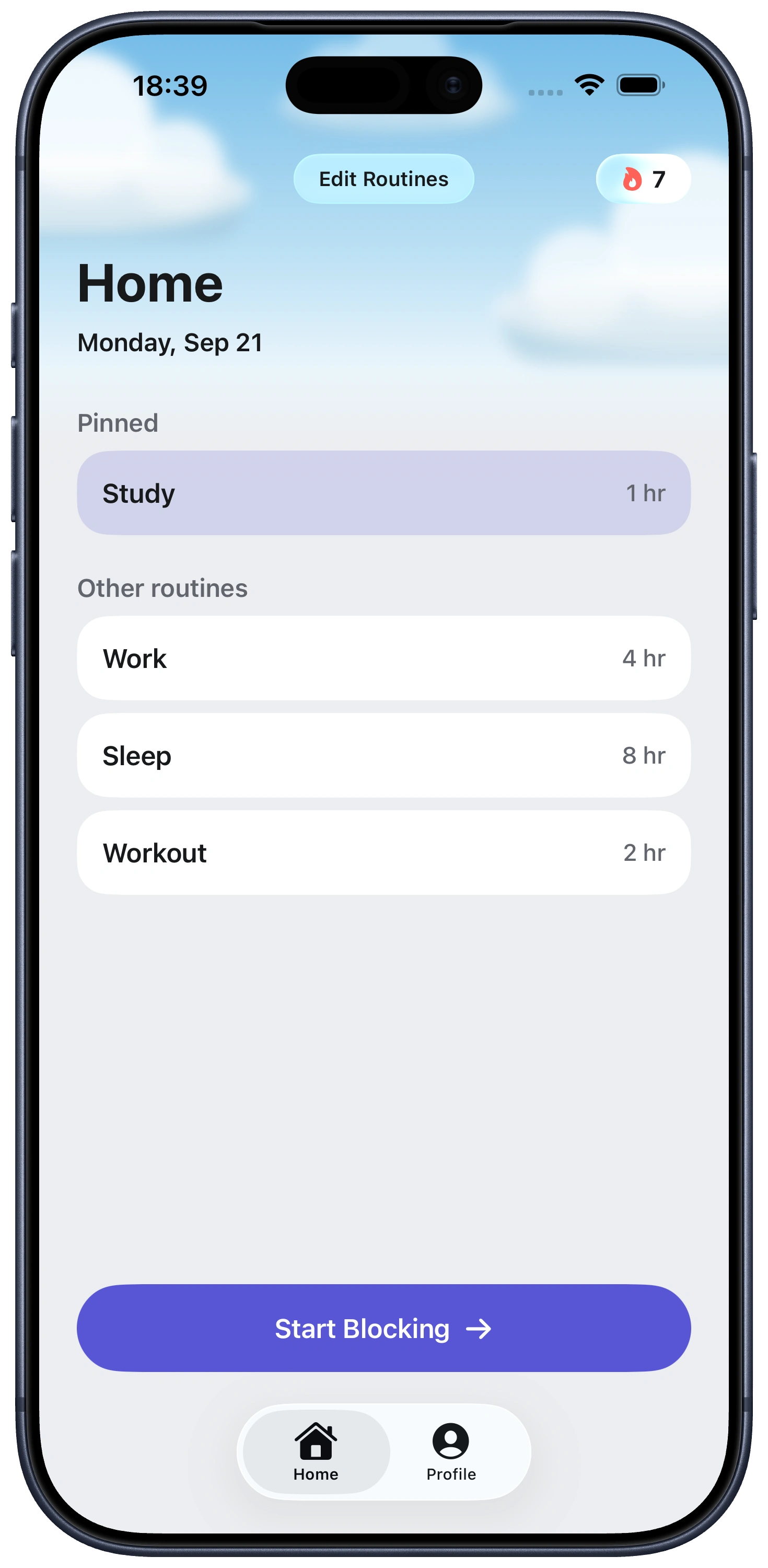
Fella isn't a Pomodoro app. There's no interval timer, no session to start, and no cycle count to configure.
Pair it with whatever timer you like. A phone timer, Forest's tree, or a plain kitchen clock can run the 25/5 rhythm, while Fella keeps the apps you choose blocked by default the entire time, session and break alike, with one 5-minute emergency unlock if something real comes up.
Pomodoro and app blocking FAQ
Most don't. Purely timer-focused apps like PomoFocus just count down the interval, with nothing stopping you from switching to another app. Forest and Flora add gamified consequences for leaving, and AppBlock builds real app and website blocking directly into its Pomodoro intervals.
Francesco Cirillo developed it in the late 1980s using a tomato-shaped kitchen timer, after experimenting with intervals from two minutes up to a full hour and settling on 25 minutes as the length that worked best for him personally.
The evidence is mixed. It aligns with research on natural attention cycles and has been shown to help manage multitasking, but other studies have found it can increase fatigue faster than self-regulated breaks and disrupt flow state on tasks that need more than 25 minutes to get into.
Knowledge workers already switch tools or tasks roughly 47 times a day, and it takes over 23 minutes on average to regain deep focus after an interruption, so an unblocked break can easily consume the next session too.
Forest locks distracting apps during Deep Focus sessions, Flora offers a similar gamified lock, and AppBlock builds customizable work and break intervals directly around its own app and website blocking, including a Strict Mode that resists mid-session changes.
No. Fella doesn't have an interval timer or session UI. It keeps chosen apps blocked all day by default, which covers both a Pomodoro session and the break after it without needing to configure a timer at all.
Yes. Use any timer, a phone app, a kitchen timer, or a calendar block, for the work/break rhythm, while Fella handles keeping distracting apps blocked throughout both the session and the break.
See also block apps while studying, the app blocker for students guide, the app blocker for ADHD, or block apps during work.