
App blockers with passwords, partners, or approval controls
Choose between a partner-held Screen Time passcode, unlock approval, bypass notifications, or a strict personal blocker—without handing over your phone security.

Trusted by 500+ people
Choose between a partner-held Screen Time passcode, unlock approval, bypass notifications, or a strict personal blocker—without handing over your phone security.
Trusted by 500+ people

The simplest free setup: ask a trusted person to create and retain a separate Screen Time passcode after you configure App Limits or Downtime. The stronger social setup: use a purpose-built blocker where a partner approves unlocks or sees bypass attempts.
Password protection and accountability are not the same. A password protects settings. Accountability adds another person, an agreement, and usually an approval or notification workflow. Decide which failure you need to prevent: impulsive setting changes, silent bypasses, or repeated “emergency” requests.
| Model | Who controls the exception? | Best fit | Weak point |
|---|---|---|---|
| Screen Time passcode | Person who knows the code | Free limits with a trusted person nearby | Apple Account recovery and device ownership still matter |
| Partner approval blocker | Paired accountability partner | Remote approval and visible bypass attempts | Depends on partner availability and product rules |
| Strict self-blocker | Predefined emergency mechanism | Privacy and independence | No human judgment for unusual situations |
| Parental controls | Parent or guardian through Family Sharing | A child’s managed device | Not an appropriate covert-control system for adults |
1. Agree on the rules first. Choose the apps, daily allowance or Downtime hours, Always Allowed essentials, and circumstances that justify a change.
2. Configure Screen Time. Set App Limits or Downtime, enable blocking at the limit, then test every essential app.
3. Lock the settings. Go to Settings > Screen Time > Lock Screen Time Settings. The partner enters a four-digit code the blocked person does not know.
4. Understand recovery. Apple recommends Screen Time Passcode Recovery through an Apple Account. If the blocked user owns that recovery account, they may be able to reset the passcode. If another person controls recovery, consider the trust, access, and account-recovery risks carefully.
5. Review after one week. The partner should not approve changes in the heat of every urge. Use a defined review time unless access is genuinely urgent.
Never give an accountability partner the iPhone unlock passcode, Apple Account password, email password, banking credentials, or two-factor authentication codes. A separate Screen Time passcode is enough for this method.
A partner blocker can make the social agreement visible inside the product. Useful features include remote unlock requests, partner approval before rule changes, a record of bypass attempts, mutual rather than one-way blocking, and clear privacy boundaries. If you are still choosing a tool, see our app blocker options for iPhone.
LockPact currently describes a mutual iPhone system where each partner chooses apps, the other partner approves unlocks, and bypass attempts generate a notification. Its site says the core pairing, locking, bypass detection, and unlock-request features are free, while an optional one-time purchase removes an accountability ad. Both partners currently need iPhones.
Sheppie describes a “Shepherd” model where a trusted person locks limits and approves changes. Its current App Store listing says the person setting their own limits needs a paid subscription, while acting as someone’s Shepherd is free.
These are examples, not blanket endorsements. Verify live pricing, recent reviews, privacy terms, iOS compatibility, what happens if a partner disappears, and whether deleting or changing permissions affects an active block. Product features can change after publication.
Consent must be explicit. Adults should choose the arrangement voluntarily and be able to end it through an agreed process. Do not install monitoring or controls secretly.
Share the minimum. Prefer a tool that shares limit settings and unlock events rather than browsing history, message content, or exact app activity. Apple’s Screen Time framework can limit the app-name data available to developers, but every product’s design and server use still differs.
Protect essential access. Leave Phone, maps, authentication, health, transportation, work escalation, and caregiving tools available as needed. Define what the partner should approve immediately and what can wait.
Choose a reliable partner. The best person is calm, consistent, and willing to follow the agreement—not someone likely to shame, bargain, disappear, or use access as leverage.
For children, use Apple Family Sharing and age-appropriate parental controls managed by a parent or guardian. Do not represent an adult as a child merely to gain stronger control.
Human approval is valuable when exceptions require judgment, but it also creates coordination overhead. A personal blocker fits better when you want privacy, live alone, work irregular hours, or do not want another person involved in every unlock.
Fella supports focus sessions and scheduled routines. During each active blocking session, selected apps stay blocked, with one 5-minute Emergency Unlock available; after that, the selected apps automatically reblock. The limited exception handles a verification code, message, or quick task without handing permanent control to a partner.
Be clear about the tradeoff: Fella does not have a partner mode, partner-held password, partner approval workflow, usage monitoring, or parental controls. Choose it for private, self-managed blocking with a predictable emergency mechanism—not for social accountability.
Write down: what is blocked, when the rule is reviewed, what counts as urgent, how quickly a partner is expected to answer, what data the partner can see, and how either person can end the arrangement safely.
A useful unlock request includes the app, the exact task, and the time needed: “I need WhatsApp for five minutes to retrieve the address.” A vague request such as “I need it” invites negotiation. Afterward, review repeated exceptions and move essential functions to an allowed channel where possible.
Everything you need to stay focused, right from Home.
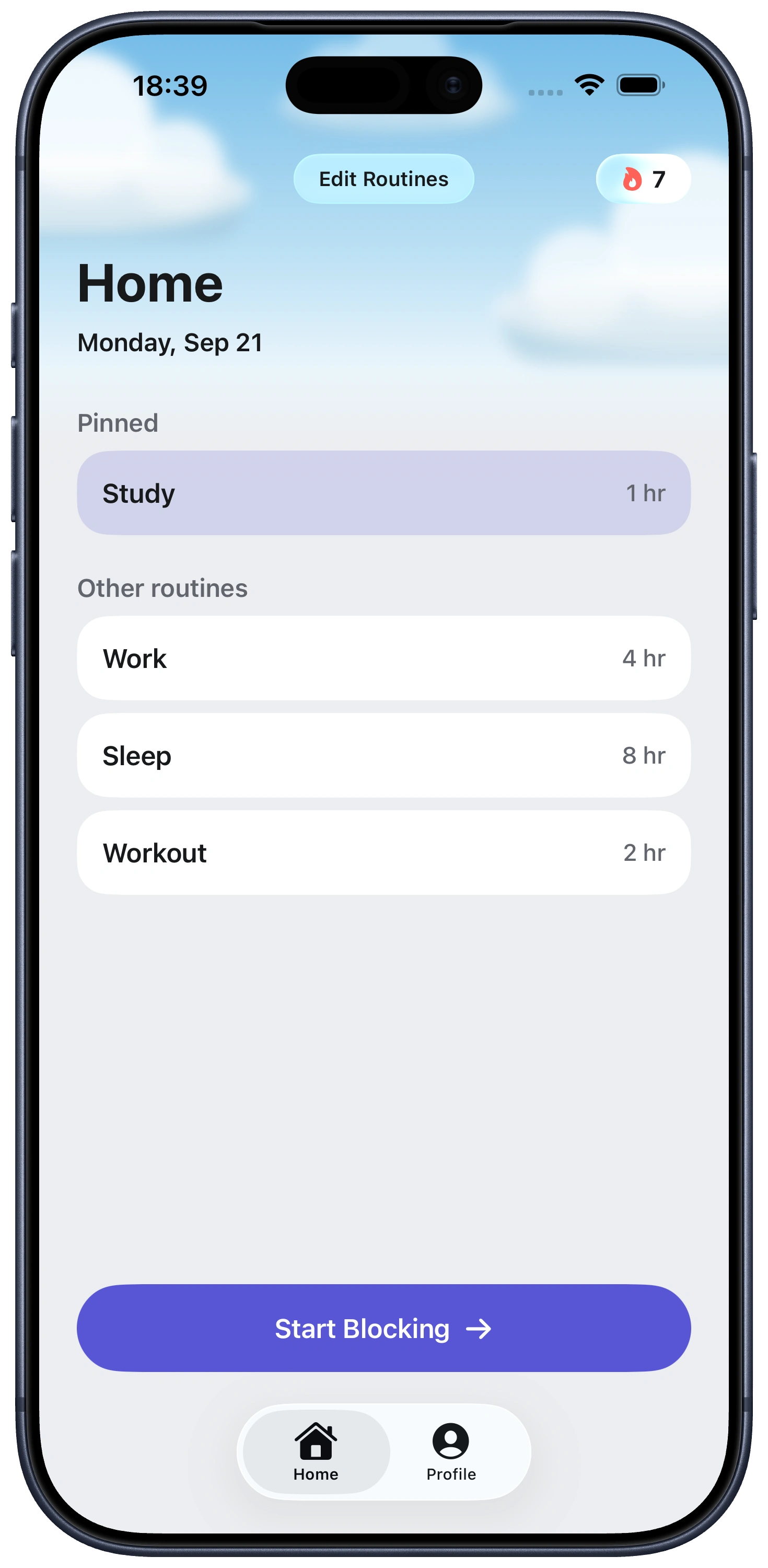
A trusted person can enter and retain a separate Screen Time passcode for a consenting adult's self-control setup. Do not give them the iPhone device passcode or Apple Account password, and understand that Apple Account recovery may still let the owner reset Screen Time.
It is a blocker where a trusted partner approves changes or unlock requests, receives bypass alerts, or otherwise helps enforce a rule instead of leaving every override with the blocked user.
That depends on the product. Some partner blockers expose only rules or unlock events, while monitoring products may share activity. Read the privacy policy and permission screen before pairing.
No. Fella is a private self-managed blocker with focus sessions and scheduled routines. Each active blocking session includes one 5-minute Emergency Unlock, then selected apps automatically reblock. It does not offer partner approval or a partner-held password.
Agree in advance on urgent-access rules, response expectations, and a safe exit process. Never let an app blocker prevent access to emergency calling, medical, travel, authentication, or essential caregiving tools.
Not necessarily. A romantic partner holding daily unlock control over your phone can create its own friction. Some people prefer a friend, a coach, or a support contact specifically to keep the arrangement outside the relationship.
Yes, at any point by agreement. Since the blocked person often controls Apple Account recovery, ending the arrangement is usually straightforward, which is worth discussing honestly before starting.