
Choose an app blocker with
emergency access
Compare blockers that preserve necessary access without making every block optional. Look for a short window, a clear usage limit, and automatic relocking.

Trusted by 500+ people
Compare blockers that preserve necessary access without making every block optional. Look for a short window, a clear usage limit, and automatic relocking.
Trusted by 500+ people

An app blocker with emergency access keeps distracting apps unavailable while preserving a limited route to something you genuinely need. That might be a login code, travel confirmation, message, specific link, or account setting.
The right model sits between two bad extremes. A completely unbreakable block can prevent a legitimate task; an endlessly bypassable block becomes optional. Controlled emergency access defines how long access lasts, how often it is available, and what happens when it ends.
| Approach | Good for | The downside |
|---|---|---|
| Completely unbreakable block | Apps you never need during the block. | A real message, code, booking, or account task may become inaccessible. |
| Endlessly bypassable block | Maximum flexibility. | Repeated overrides can make the block optional. |
| Controlled limited emergency access | Apps that are distracting but occasionally necessary. | The window must cover the task without becoming open-ended access. |
Choose controlled access when both strictness and occasional utility matter. The blocker should state the duration, frequency, and relocking behavior before you depend on it.
| Blocker | Mechanism | Bounds |
|---|---|---|
| Fella | One 5-minute Emergency Unlock per active blocking session | Once per session; selected apps relock automatically when the unlock or session ends |
| Jomo | Emergency Mode (Profile → Help & Feedback), suspends Strict Mode or deletes a rule | Capped at 2 uses per week; can be PIN-gated |
| Freedom | Session Break, lifts a running block for a set period without ending the session | Free on all plans; in Locked Mode, capped at 1 break per session per calendar day |
These are three different mechanisms, not three versions of the same feature. Jomo's Emergency Mode changes or removes a rule; Freedom's Session Break pauses a session without touching the rule; Fella's Emergency Unlock does neither — it's a fixed window on an unchanged rule. None of them claim to be impossible to bypass; the bound (how long, how often, what happens after) is what actually determines how trivial or useful the exception is. If the cap itself is what you're comparing, see how an app blocker with limited unlocks works.
Open a team message, group update, course link, or reply that someone shared in a distracting app, then return to what you were doing.
Retrieve an authentication code, complete an account task, or find a confirmation without keeping the app available by default.
Check a booking, travel detail, event update, or a message you need now. The point is to finish that task, not start another scrolling session.
Bounded duration. The exception should last a fixed, short amount of time, not an open-ended pause you have to remember to end yourself.
Bounded frequency. One unlock per session, or a weekly or daily cap, keeps the exception from quietly becoming the new default state.
Automatic reblocking. You should not have to remember to restart a blocker after finishing the task — the app should relock on its own.
Clear rules. You should know exactly what triggers the access, how long it lasts, and how often you can use it, before you need it.
Enough access for a legitimate need, and no more. Enough time for a message, a code, or a booking confirmation; not enough for a scrolling session. See why bounding it this way matters instead of just leaving a block wide open.
Fella is one example of this category, not the whole category. Choose the distracting apps you want blocked, start a focus session or set up a scheduled routine, and each active blocking session gets one 5-minute Emergency Unlock before selected apps relock automatically. For a broader look at available tools, see our free iPhone app blockers.
Fella does not claim to be an impossible-to-bypass system. For the iOS limits behind that distinction, read whether an app blocker can really be impossible to bypass. For the full breakdown of how the Emergency Unlock works, see the dedicated Fella Emergency Unlock page.
This fits when an app has a real, occasional purpose. For example, a message thread, authentication flow, group update, travel confirmation, or account setting—and you do not want the app available for casual checking. Fella covers this with a focus session you start yourself or a routine that starts one on a schedule.
It's not the fit if you need a family-management system or an app that can never be changed or bypassed — those are different products. It also may be unnecessary if you never need the app: deleting it is simpler.
For the habit side of the problem, read how to stop opening apps automatically.
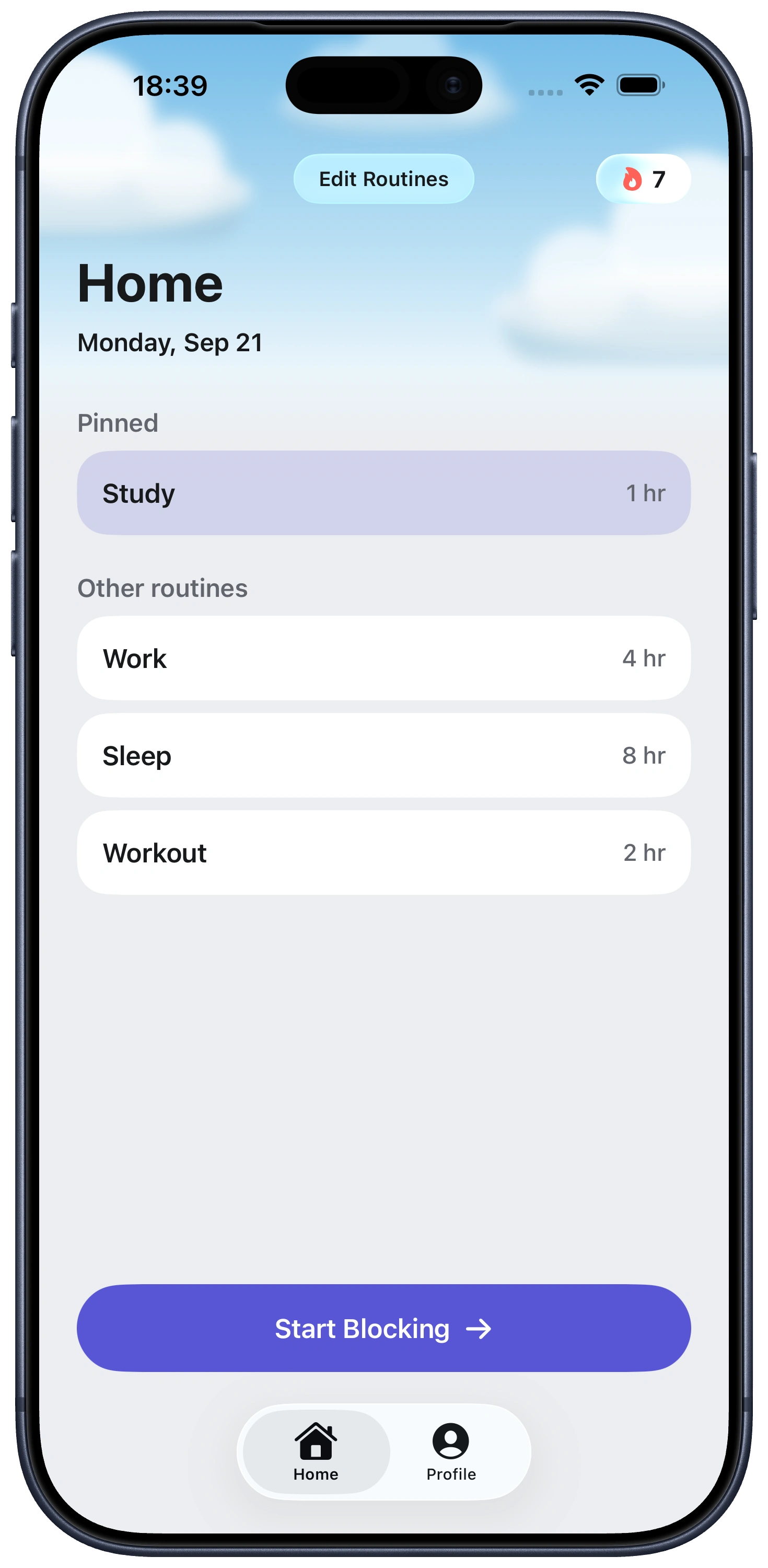
Everything you need to stay focused, right from Home.
It blocks selected apps by default but gives you a short, intentional access window for a necessary task. The window should end automatically so access does not become open-ended.
Use it for a real need inside a blocked app, such as a message, login code, travel detail, account access, or specific link.
This model fits people who need occasional access to a distracting app for messages, login codes, travel details, account tasks, or specific links, but do not want an unlimited or repeatedly bypassable block.
No. Controlled emergency access has a defined duration and frequency and ends automatically. An unlimited or repeatable bypass can make the block optional whenever you want more time.
No. Mechanics vary by product. Fella gives one 5-minute Emergency Unlock per active blocking session with automatic relock. Jomo's Emergency Mode can suspend Strict Mode or delete a rule, capped at 2 uses per week. Freedom's Session Break lifts a block for 5 minutes without ending the session, capped at 1 per day in Locked Mode.
Delete apps you do not need. Choose controlled access when you need an app sometimes but do not want it available for reflexive checking.