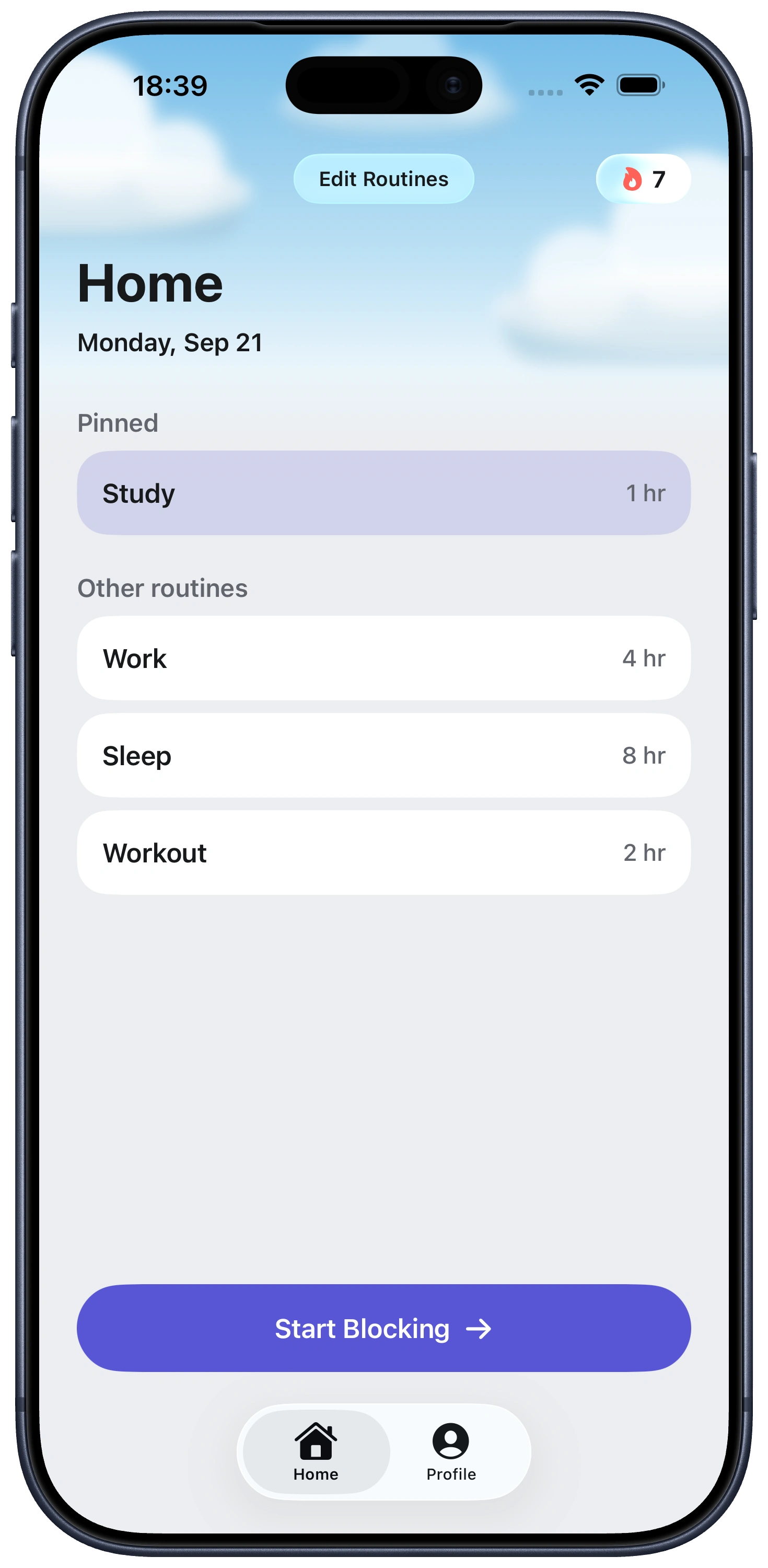
Deep Work App Blocker
1,200 app switches
a day isn't focus.
Knowledge workers switch tasks every 3 minutes and take 23 minutes to recover from a real interruption. Fella blocks distracting apps by default and gives you one 5-minute unlock a day, so your phone stops being one of the 1,200 switches.
Gloria Mark's research group at UC Irvine has spent years measuring what actually happens to attention during a workday, and the numbers are stark. Knowledge workers switch tasks every 3 minutes on average, with a genuinely significant interruption landing roughly every 11 minutes. Across apps and websites specifically, that adds up to nearly 1,200 switches a day, costing an estimated 4 hours a week in pure reorientation, before accounting for the interrupting task itself.
Recovery from a real interruption takes an average of 23 minutes and 15 seconds to fully regain focus, and a single interruption often cascades into 2.26 additional task switches before the original task gets resumed. Zoomed out to the level of an entire economy, the estimated cost of context switching runs around $450 billion a year, and individual workers are estimated to lose 40 to 67% of their potential productivity to switching and recovery combined.
Why deep work depends on protecting long stretches, not willpower
The knowledge-work idea of "deep work," cognitively demanding effort performed without distraction, depends on stretches of time long enough to reach and sustain concentration. A phone check doesn't just cost the seconds it takes. It resets the clock on a state that, per the UC Irvine data, takes over 23 minutes to rebuild. Eight to ten unwanted interruptions across a workday, a realistic number for most people, adds up to roughly two hours of pure refocus tax on top of whatever the interruptions themselves cost.
This is why "just have more discipline" rarely fixes the problem. Willpower operates at the moment of temptation, checking or not checking, but the actual cost is paid afterward, in the 23 minutes it takes to get back to where you were. No amount of willpower in the moment recovers time already lost to the interruption before it.
The phone is a uniquely bad interruption source
Not every interruption is equal. A coworker's question is bounded, it resolves and you return to work. A phone in reach is an open-ended interruption source: the notification that triggers the first check often isn't the thing that keeps you there. One app leads to another, and the 3-minute switching interval measured in the research compounds fast once a phone is involved.
Distracting apps are also specifically engineered to extend a single check into a longer session, infinite feeds, autoplay, algorithmic recommendations. A quick glance at a notification and a 20-minute scroll session both start the exact same way, with the phone leaving your pocket.
Why session-based focus tools only solve half the problem
Pomodoro timers and session-based focus apps are genuinely useful for the time you remember to protect. Their limitation is the boundary: they only work during an active session, which means every unscheduled minute of the day, between meetings, waiting on a build, during a commute, remains fully open to the same 1,200-switches-a-day pattern the research describes.
Fella blocks selected apps by default using Apple's Screen Time framework, with no session to start and no timer to set. One 5-minute emergency unlock a day covers a genuine need, and it locks itself back up automatically when the window ends, so the protection isn't limited to the hours you remembered to schedule it.
Deep work looks different by role
Remote workers lose the office's built-in social friction against phone use. See the app blocker for remote workers guide.
Freelancers have no manager to notice a distracted afternoon, and procrastination affects an estimated 95% of the self-employed. See the app blocker for freelancers guide.
Developers hold a fragile mental model that a single notification can erase. See the app blocker for developers guide.
Entrepreneurs face decision fatigue from thousands of daily choices, making a distracting app the easiest one to say yes to. See the app blocker for entrepreneurs guide.
Deep work app blocker FAQ
Research from UC Irvine tracks knowledge workers switching tasks every 3 minutes on average, with significant interruptions occurring roughly every 11 minutes, and around 1,200 app or website switches happening in a typical day.
The same UC Irvine research found it takes an average of 23 minutes and 15 seconds to fully regain focus after a significant interruption.
Estimates put the cost of context switching across the economy at roughly $450 billion a year, with individual workers losing an estimated 40 to 67% of potential productivity to switching and recovery time.
Session-based tools require you to start a timer before the block takes effect. Fella blocks selected apps by default, all day, with one emergency 5-minute unlock, so there's no session to remember to begin.
Read more on the psychology behind this in attention residue and context switching cost.